Printed range
Printed Polyester Fabric
Custom printed 100% polyester fabric produced on our own rotary screen and digital lines, from 65 to 120 gsm and up to 280 cm wide.
View rangeFour print methods, one piece of artwork, four different outcomes on handfeel, fastness and cost per metre. The right choice depends on quantity and on how the fabric will be washed — not on which method sounds most advanced.
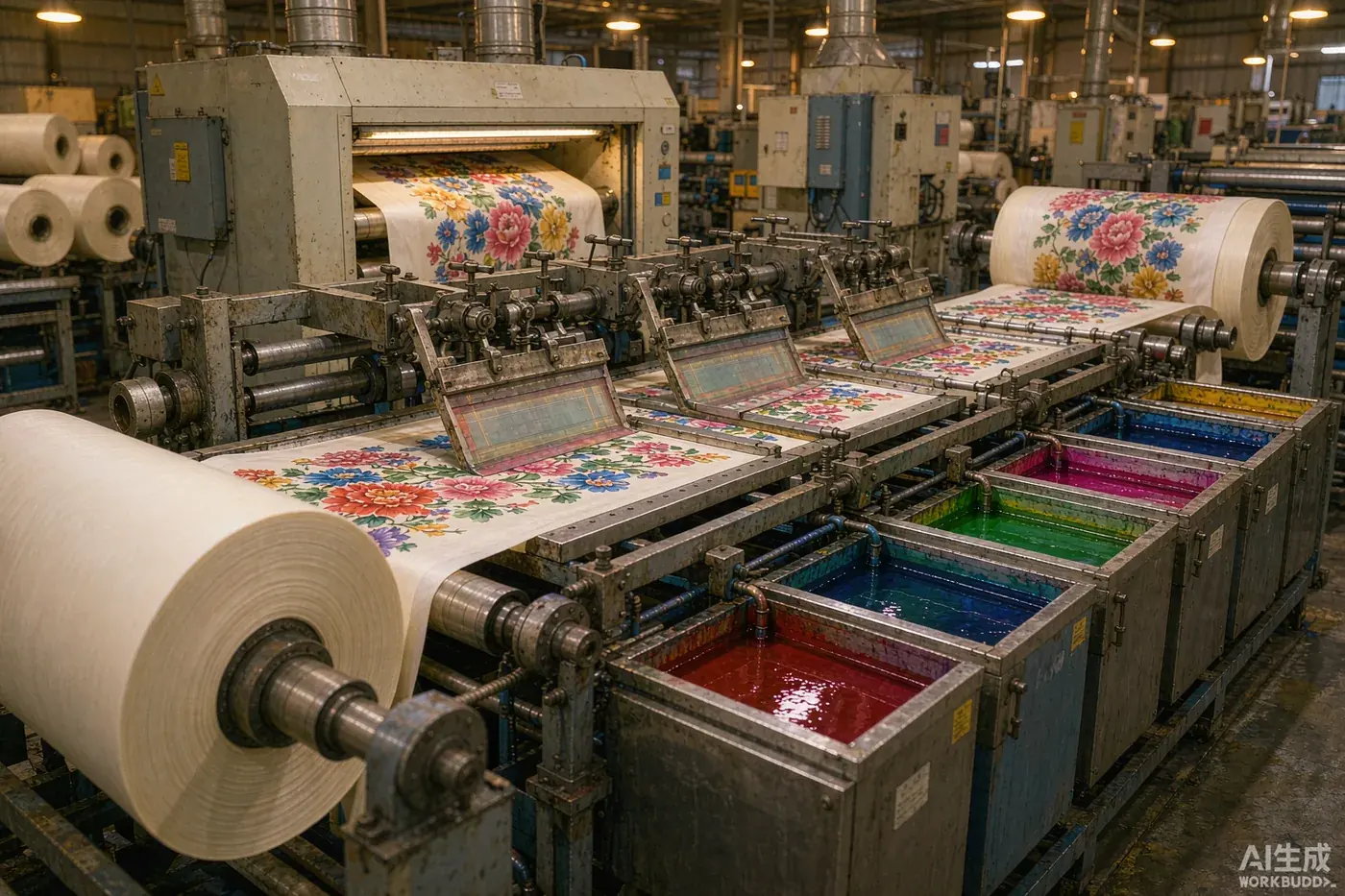
Printing is where most of a bedding programme's visual value is created, and where most sampling delays come from. Understanding what each method does well makes the sampling round shorter and the bulk order more predictable.
| Method | Strengths |
|---|---|
| Rotary screen | Lowest cost per metre at volume, strong colour depth, 4–12 colours, consistent across long runs |
| Pigment print | Sharp outlines, bright whites, economical short runs, works on any fibre |
| Disperse print | Softest handfeel, good wash fastness, the standard for polyester bedding |
| Digital print | Unlimited colours, photographic detail, no screen cost — ideal for sampling and small runs |
A separate engraved screen is needed for each colour, so setup cost is real. Once the screens are made, the cost per metre is the lowest of the four methods, and colour depth is excellent because a thicker ink film can be laid down. For a design that will run for several seasons, or across several colourways, screen printing almost always wins on total cost.
The constraint is the number of colours. Beyond 10–12 the screens become expensive and registration becomes harder to hold on a soft fabric.
Pigment sits on the surface of the fibre rather than bonding into it. That gives crisp edges and clean whites, and it allows very short runs because there is no washing step afterwards. The trade-off is handfeel — pigment can leave the fabric slightly drier and stiffer than disperse print, which matters on a duvet cover that will be against skin.
For cushion covers, table linen and decorative panels, pigment is often the better choice. For bedding that will be washed weekly, it usually is not.
Disperse dyes bond with polyester at high temperature, which means the colour becomes part of the fibre rather than a layer on top. The result is a soft handle and good wash fastness — exactly what a bedding product needs. If a buyer asks for "print that feels like the fabric", this is the method they mean.
Digital has no screen cost, so the economics flip at low volume. It is the fastest route to a strike-off, which makes it valuable even if bulk production later moves to rotary screen. Its limitations are speed, ink cost at volume, and slightly lower colour saturation on very bright shades.
Artwork in vector format or at least 300 dpi, the repeat size, the number of colours, and a physical reference for the colour you expect. Add the end product and the expected wash cycle — a mill cannot recommend a method without knowing whether the fabric is a duvet cover or a cushion. If you are matching an existing product, send a production sample from that product, not a photo: substrate and ink both shift the final colour.
We print on our own rotary and digital lines and will tell you which method fits before quoting. If a design is better printed elsewhere, we say so — a failed programme costs more than an honest recommendation.
Custom printed 100% polyester fabric produced on our own rotary screen and digital lines, from 65 to 120 gsm and up to 280 cm wide.
View rangePeach skin is created by brushing the surface of the fabric after dyeing, lifting fine fibres into a velvety nap.
View rangeSend the product you are working on and the numbers you are unsure about. Technical answers come from the team that runs the orders.